
Blog
Review of Crime 101 – A Spectacular and Captivating Deception


Crime 101
Genre: Thriller, Crime
Crime 101 is a film aimed at audiences who enjoy psychological crime stories, where characters are slowly developed, carefully dissected, and portrayed as multifaceted individuals who feel as if they truly exist somewhere within society.
The film creates a spectacular deception by using its trailer as a smokescreen. In many ways, that misdirection perfectly reflects the essence of the movie itself. Surprisingly, this approach does not harm the film; instead, it becomes one of its most intriguing qualities.
Director Bart Layton constructs not only a sophisticated narrative puzzle but also pushes the story beyond the boundaries of a conventional action movie. One of the film’s biggest highlights is the unexpected performance by Chris Hemsworth, which defies audience expectations.
Police and Criminals – A Timeless Story

Crime 101 begins on the complex highway system of Los Angeles, where master thief Mike Davis (Chris Hemsworth) operates. Over the years, Mike has stolen millions of dollars worth of valuables while effortlessly evading the police.
Each heist follows a strict set of rules:
No one gets hurt.
No trace is left behind.
No identification.
The operation must be perfect.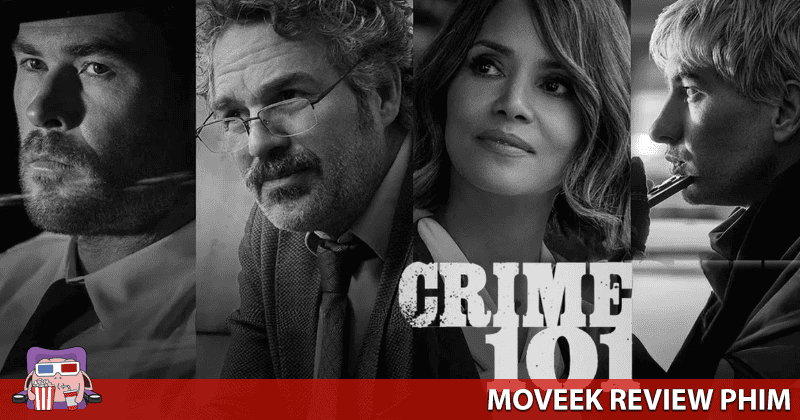
However, Mike’s criminal career reaches a dangerous turning point when he begins dreaming of a normal life. In a world built on lies and anonymity, such a desire can be fatal.
Meanwhile, Inspector Lou (Mark Ruffalo) relentlessly hunts him down. Lou is a man with no clear personal life, no family, and no significant career progression, yet he is deeply obsessed with catching Mike.
To finally capture the elusive thief, Lou teams up with Sharon (Halle Berry), a veteran insurance investigator. Together they devise a carefully calculated trap.
However, an unpredictable element threatens both sides: Ormon (Barry Keoghan), an amateur criminal whose chaotic nature disrupts every carefully planned move.
A Spectacular Twist

Based on the trailer, the star-studded cast, and the flashy imagery of high-speed cars and weapons, many viewers might expect Crime 101 to resemble a mix of Fast & Furious, Baby Driver (2017), and The Italian Job (2003).
Yet in the era of neo-noir crime films such as Drive (2011), Heat (1995), and Live by Night (2016), Bart Layton’s film delivers a surprising narrative trick that subverts these expectations.
At its core, the movie remains an action–crime–heist story. However, the familiar conventions of the genre are reshaped and reconstructed in distinctive ways.
Common tropes are dismantled, resulting in a film that consistently challenges what audiences anticipate.
Breaking the Familiar Formula

Crime 101 refuses to follow the classic structure of “plan – failure – redemption.”
Bart Layton appears inspired by the cinematic style of neo-noir master Michael Mann, focusing his camera on the people behind the roles of criminals, police officers, and ordinary citizens.
A comparable example is Drive (2011), where Ryan Gosling portrays an unnamed criminal forced to reconsider his life after a turning point.
A Film That Studies Its Characters
While Drive presented a world of irreversible, violent masculinity, Crime 101 explores something more universal.

Over its two-hour runtime, Bart Layton crafts what feels like a jazz-like urban symphony, revealing four individuals trapped within a destructive social vortex that slowly erodes morality.
Although the story contains many criminal acts, its true core lies in character exploration. More specifically, the film presents four interwoven character studies connected by threads of fate.
After the tense opening carjacking scene, the film deliberately slows down, shifting its focus toward the emotional struggles and inner conflicts of each character.
The endless highways of Los Angeles become powerful visual metaphors for the characters’ lives—uncertain, exhausting, lonely, and constantly under pressure.
A Cast That Delivers
Although the film remains a crime thriller, it uses emotion as the driving force rather than relying purely on action.
The twists in the narrative appear sparingly, but when they do, they are unpredictable and impactful.
Instead of presenting traditional heroes, the story places audiences in the perspective of morally ambiguous individuals. The unsettling part is that the film does not necessarily make viewers like these characters—it simply places them at the edge of empathy.

This approach works largely because of the film’s exceptional cast.
Chris Hemsworth delivers a surprising performance, portraying a thief far removed from his familiar on-screen persona.
Halle Berry brings emotional depth to Sharon, creating a character that feels sympathetic and human.
Barry Keoghan injects unsettling unpredictability into the role of Ormon.
Meanwhile, Mark Ruffalo once again demonstrates his strength as an actor by portraying a man worn down by life.

Who Is Crime 101 For?
With a strong script and carefully crafted characters, Crime 101 becomes a well-rounded cinematic experience.
The film contains action, emotion, romance, and moments of genuine pain. Bart Layton ensures that his project never lacks compelling elements.
However, originality comes with a price. The slow pacing typical of character-study films may challenge viewers who prefer faster storytelling.
This is ultimately a film for audiences who appreciate psychological crime narratives where characters are explored slowly and presented with depth.
In this story, the criminal aspect sometimes becomes secondary to the exploration of human nature.
Is Crime 101 a good film? The answer is yes. But it is not intended for those seeking nonstop action or constant shocking twists.
Instead, the film resonates most with viewers who enjoy thoughtful, contemplative cinema that explores the complexity of human behavior.